via grammy.com

The 2026 GRAMMYS take place Sunday, Feb. 1, at Crypto.com Arena in Los Angeles, broadcasting live on the CBS Television Network and streaming live and on demand on Paramount+. Watch highlights and exclusive GRAMMYS content from the 2026 GRAMMYS all year long on live.GRAMMY.com.

Best Jazz Performance

“Noble Rise” – Lakecia Benjamin Featuring Immanuel Wilkins & Mark Whitfield

Best Jazz Vocal Album

ElementalDee Dee Bridgewater & Bill Charlap

Best Latin Jazz Album

Arturo O’Farrill & the Afro Latin Jazz Orchestra Featuring Pedrito Martínez, Daymé Arocena, Jon Faddis, Donald Harrison & Melvis Santa

A Tribute to Benny Moré and Nat King ColeGonzalo Rubalcaba, Yainer Horta & Joey Calveiro

Best Contemporary Instrumental Album

BEATrioBéla Fleck, Edmar Castañeda, Antonio Sanchez

Best Bluegrass Album

Carter & ClevelandMichael Cleveland & Jason Carter

Best Traditional Blues Album

Young Fashioned Ways – Kenny Wayne Shepherd & Bobby Rush

Best Regional Roots Album

A Tribute to the King of Zydeco – (Various Artists including C.J. Chenier & Marcia Ball)

Best Global Music Performance

“Shrini’s Dream (Live)” – Shakti

Best Global Music Album

Mind Explosion (50th Anniversary Tour Live) – Shakti

Best Compilation Soundtrack for Visual Media

Sinners – (Various Artists including Bobby Rush & Cedric Burnside)

via Downbeat.com

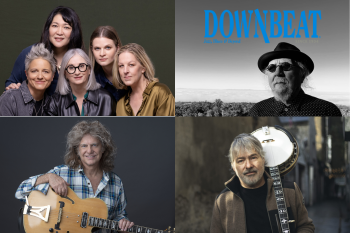
DOWNBEAT 90th ANNUAL READERS POLL WINNERS

Group of the Year

Artemis

Flute

Charles Lloyd

Guitar

Pat Metheny

Beyond Instrumentalist

Béla Fleck (Banjo)

NOMINEES

Hall of Fame

Dee Dee Bridgewater

Abdullah Ibrahim

Arturo Sandoval

Artist of the Year

Charles Lloyd

Pat Metheny

Wynton Marsalis

Bill Charlap

Cécile McLorin Salvant

Group of the Year

Charles Lloyd Quartet

Pat Metheny Side-Eye

SFJAZZ Collective

Béla Fleck, Edmar Castañeda, Antonio Sanchez Trio

Album of the Year

Bill Charlap Trio, And Then Again

Jazz At Lincoln Center Orchestra with Wynton Marsalis, Freedom, Justices And Hope

Béla Fleck/Edmar Castañeda/Antonio Sanchez BEATrio

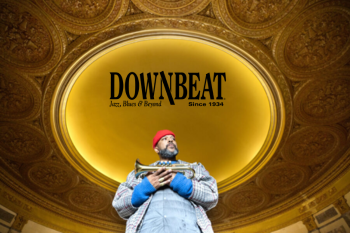
Trumpet

Wynton Marsalis

Soprano Saxophone

Ravi Coltrane

Alto Saxophone

Lakecia Benjamin

Tenor Saxophone

Charles Lloyd

Flute

Lakecia Benjamin

Piano

Bill Charlap

Guitar

John Pizzarelli

Electric Bass

Meshell Ndegeocello

Percussion

Poncho Sanchez

Pedrito Martínez

Beyond Instrumentalist

Brandee Younger

Female Vocalist

Cécile McLorin Salvant

Dee Dee Bridgewater

Veronica Swift

Male Vocalist

Bobby McFerrin

John Pizzarelli

Composer

Pat Metheny

Wynton Marsalis

Arranger

Wynton Marsalis

Producer

Don Was

Blues Artist of the Year

Marcia Ball

Bobby Rush

Blues Album

Bobby Rush & Kenny Wayne Shepherd, Young Fashioned Ways

Beyond Artist

Béla Fleck

Meshell Ndegeocello

Beyond Album

Meshell Ndegeocello, No More Water: The Gospel of James Baldwin

Read the Full Article

via pbssocal.org

STREAM on the free PBS App from Nov. 27 – Dec. 24, 2025

WE ❤️ PUBLIC TELEVISION! is a three-hour fundraising program broadcast LIVE on
November 8, 2025. A star-studded cast will honor 55 remarkable years of public
television.

Featured talent (subject to change) includes music director Rickey Minor, and appearances by Josh Groban, Jamie Lee Curtis, Ken Burns, Ziggy Marley, Lily Tomlin, Henry Louis Gates, Jr., Marlee Matlin, Noel Paul Stookey, Rick Steves, David Foster and Katharine McPhee, Adam Arkin, Courtney B. Vance, Martha Plimpton, Bill Nye, Joe Bonamassa, Sheléa, Jesse Cook, Judy Blume, Celtic Woman, Mychal the Librarian, Lindsey Stirling and many more. The telethon will include three special performances from the Nashville PBS studios featuring Kathy Mattea, Sierra Hull, Molly Tuttle and Ketch Secor.

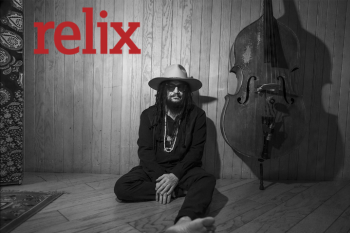
via relix.com

“There was a period in my life where I got to work with all my heroes. I got to work with Bob Dylan and watch him write. I got to work with Willie Nelson, Brian Wilson, Kris Kristofferson, and Mick and Keith. When I saw what they were doing, it gave me writer’s block for about five or six years,” Don Was reveals, as he acknowledges the immediate impact of producing records for such masterful artists. “Every time I sat down at a piano, I’d think, ‘What’s the point of this when these guys are just down the street and can do it way better?’”

Eventually, a moment of epiphany arrived, while he was working on a session with Willie Nelson.

“I looked at him, and I thought, ‘Man, he’s so great. He’s such a brilliant, one-of-a kind person, and I can never be as good as this guy,” Was recalls. “But then it hit me that, on the other hand, he can’t be me. He didn’t grow up in Detroit, drop acid and go see the MC5 at Grande Ballroom. George Clinton and the Parliaments didn’t play a sock hop at Willie Nelson’s junior high school. The Stooges didn’t play at his high school. So I had all these experiences that he didn’t have.”

This backdrop ultimately informed his approach as he assembled some like-minded players for a special live event he performed at the behest of Terence Blanchard in May 2024. “I decided to find people who grew up listening to the same radio stations that I did and be as extreme Detroit as I could be,” Was explains. “I realized that just about no one else is doing that, certainly not at my age of 73. Mitch Ryder is still out there playing. Iggy’s out there playing, but there aren’t a whole lot of folks from that era. So I put together a band of people who I knew, some of whom I’ve been playing with for 45 years. We already had a common language.”

Don Was and The Pan-Detroit Ensemble share that soulful, jazz-infused vernacular on their studio debut, Groove in the Face of Adversity.

The title of the record had been a long time coming, as it originated from an experience during the bass player’s teenage years.

“My mom was making me run errands with her on a Saturday, and I hated it,” he remembers. “I wanted to be hanging out with my friends, and I was being the worst 14-year-old boy that I could be. At one point, she finally stopped taking me into stores, left me in the car with the key and told me to listen to the radio. So I was playing with the dial and I happened to land on Detroit’s jazz station, WCHB, which I didn’t know existed at that time. I hit it just as the solo was beginning on a song, which was a saxophone solo, I subsequently learned. It was a song called ‘Mode for Joe’ by Joe Henderson, which is a Blue Note release that was new at the time in 1966. At the beginning of the solo—this is right where I came in—it sort of breaks down and he’s doing these really anguished cries from the saxophone. He didn’t sound like any saxophone player that I knew, and it matched my mood perfectly. About 20 seconds later, the drummer, a guy named Joe Chambers who plays on a million great Blue Note records, starts hitting his ride cymbal and grooving. Then, eventually, Joe Henderson calms down and he starts moving with the groove.

“The message that came through to me wasn’t about notes or saxophones, it was Joe Henderson talking to me and saying, ‘Don, you’ve got to groove in the face of adversity.’ I thought about that and it changed my whole mood around in a couple of minutes. By the time my mom got back in the car, I was a nice kid again. I realized the transformational power of this music, and music in general. I not only respected it, but this affirmed my desire to make music and to try to do that in the world.”

Beyond supplying the name of an album nearly 60 years later, that moment opened a new world for the captivated listener, who would achieve success as an eminent performer and producer before being named president of Blue Note in 2012. “That experience in the car was my first introduction to jazz, to Blue Note and to nonverbal music’s power to communicate a strong verbal message,” Was indicates. “I stayed on that station, and it was a jock named Ed Love, who’s now in his 90s and is still on the radio in Detroit. He was the king of the jazz DJs and he back-announced every record with who was playing, so you could really go to school on him. He also hosted a series of jazz concerts at the Detroit Institute of Arts that he was advertising on that same show. I couldn’t get down there that night for Gene Harris and his trio, The Three Sounds, because I couldn’t drive. But two weeks later, he had the Jazz Crusaders and I went to that show with my buddies.”

Was maintained his appreciation for the medium, even as he pursued a variegated career that included his standout production credits, as well as participation in projects such as Was (Not Was) and, more recently, Bobby Weir & Wolf Bros. He has won multiple Grammys, including Producer of the Year, as well as an Emmy (The Beatles: The Night That Changed America), a BAFTA (Backbeat) and a Lifetime Achievement Award from the Americana Music Association.

Still, he remains curious and committed to most any creative challenge, which is what Blanchard presented him in 2022, when curating a jazz series for the Detroit Symphony Orchestra. Was agreed to participate, and eventually found himself with a looming deadline.

“Cool things came up and, all of a sudden, I was six months out from a gig that I’d accepted two years earlier. I didn’t have any songs or any band. What I did have was an awareness that every artist who records for Blue Note Records practices between three to six hours a day. When I thought about the kind of work that goes into doing what they’re doing, I realized, ‘Man, I can’t compete with that. If I try to be that, it’ll just be shitty. So what can I bring to the proceedings that is different from what everybody else is doing?’ For 30 years, I’d been driving around with a sound in my head that I wanted to achieve, but it always got moved to the back burner.”

So he decided to lean into his Detroit connections, recruiting musicians he had played with at various moments over the preceding decades. Saxophonist Dave McMurray and longtime Eminem keyboardist Luis Resto were charter members of Was (Not Was). Vincent Chandler (trombone) is a professor of jazz studies at Wayne State University. Was notes, “He’s part of a tradition of guys like Barry Harris and Marcus Belgrave who were Detroiters and stuck around to mentor people.” Jeff Canady (drums) played with Michael Henderson as well as McMurray. Wayne Gerard (guitar) also performed with McMurray as well as many others, including Bob James. John Douglas (trumpet) toured with The Four Tops and The Temptations. Mahindi Masai (percussion) played with Roy Brooks and Max Roach, as well as McMurray. Finally, Was explains that vocalist Steffanie Christi’an “is a world-class, incredible singer who, just because she chose to live in Detroit, didn’t get the attention that she should have.” As the nine musicians came together for the first time, they experienced a mutual frisson of excitement. Was recollects, “We had a rehearsal about six months before the Detroit show and it just clicked. When it clicks, you can’t ignore that. When it feels like you’ve been playing together for decades and you’ve been playing together for 10 minutes, you don’t let that slip away. You only have one, maybe two opportunities if you live long enough and have a long enough musical career and develop those kinds of relationships to have that kind of familiarity and comfort and common language—so that the conversation becomes relaxed and jocular. We had that from the get-go, so I knew we shouldn’t stop with the one gig.”

Beyond additional live performances, Mack Avenue Records has just released Don Was and The Pan-Detroit Ensemble’s vibrant, shimmering studio release, Groove in the Face of Adversity. The material that the group inhabits on the album reinforces its nine members’ range, ambition and facility. These tracks include Kenny Barron’s “Nubian Lady,” Cameo’s “Insane,” Hank Williams’ “I Ain’t Got Nothing But Time” and the Was original “You Asked, I Came,” which was originally recorded for the score to The Beatles in Hamburg biopic Backbeat.

When asked to characterize how the band’s music manifests the city that birthed it, Was asserts, “I think there’s absolutely something uniquely Detroit about what we are doing and what everybody who comes from Detroit does. I think it got its roots in the uniqueness of a one industry town. After World War II, people came from all over the world to work in these factories, and everything in that city depended upon the success of the auto business. If sales were down, people got laid off and they’d move away with their families. There’s something about everyone being in the same boat that creates a kind of root honesty to the place. There’s no point in putting on any airs. It’s a very honest population, and the music that’s come from there reflects that.”

“I cite John Lee Hooker as the greatest example of Detroit music,” he continues. “It’s so raw. You don’t know if a song’s going to fall apart in the next minute, but it never does. He also swings like crazy and he’s super soulful, but it’s utterly without polish or pretension. That follows every different alleyway of Detroit music, whether it’s Mitch Ryder, MC5, Stooges, White Stripes, J Dilla, Donald Byrd, Joe Henderson or Elvin Jones. It’s not a big, slick sound and there’s a repetitive, undulating groove underneath. The Stooges were like a rock-and-roll version of James Brown’s band. That’s the tradition, and I think we embody it.”

Don Was and The Pan-Detroit Ensemble recently shared that tradition with audiences in Japan, followed by a series of album release shows in the U.S. where, in addition to performing their existing repertoire, the group also interpreted the Grateful Dead’s Blues for Allah to celebrate the album’s 50th anniversary.

The suggestion to perform the record initially came from the Golden Road Festival in Buford, Ga. “I thought, ‘Well that’s a challenging proposition,’” Was offers. “I know the album, and, there are some standards that get played every four or five nights with Wolf Bros, and there are some that I’ve never seen played. ‘King Solomon’s Marbles’ felt like free jazz to me. I never really understood that there was an actual structure and chords underneath it that repeat. It’s been fun to really go in there and dig deep on these songs and find what the structure is and think of how we can play it. We’re playing all of them and we’re playing all of them conscientiously. The challenge of the thing is you don’t want to do karaoke Dead, but there are certain touchstones that have to be included. They’re like guardrails that people can hold onto. It’s finding out what’s sacred and what’s not and what you can play with.

“That’s something I learned playing with Wolf Bros. I can’t play like Phil. Nobody played like Phil. It was such a unique approach, and that kind of haunted me for a while. I knew that I wasn’t approaching the songs the way that he did, but what I eventually realized is that the most Phil-like thing you can do is be yourself. It certainly wasn’t about the parts he played because he played them differently every night, but he was always Phil. I can’t be Phil, so I had to learn to be me and play those songs, which I felt was in the true spirit of the music, and Bobby concurred. It’s the same with this. How do these nine people from Detroit play these songs?”

Looking ahead, the collective has also confirmed a series of dates in the new year. Beyond that, Was remarks: “I’m committed to playing with the band until I drop. I’ll do other things, but I’m sticking with this, and we’re already working on songs for our next album. To me, this one was like a handshake. It’s saying, ‘Nice to meet you, here’s who we are.’ We’re going to build on this and take it to new places. Where it’s going will be as much a surprise to me as it is to anybody else. What I do know is that since we started playing, we’ve gone to a different level of musicianship. We’ve got a lot of touring coming up and it’s going to be different by the time we finish. I can’t wait to see where it goes.”

Don Was And The Pan-Detroit Ensemble on TKA

Read the Full Article

via Downbeat.com

The remarkably distinctive and individualist style of Ben LaMar Gay places this Chicagoan multitasker at the forefront of adventurous jazz (and ritually folkloric electronica). It’s his voice and phrasing, his use of worming synths and his actual songwriting that propel Gay’s artistry, but his tightly contained cornet curlicues are also impressive. A stable band continues to make unstable music, with sensitive drums, deep tuba and rootsy guitar aiding in this quest, as well as added bass clarinet and three-part vocal chorus.

The title cut carries a gospel undertow, but with sneaky synth spirals in the background.
“The Glorification Of Small Victories” features a free-Eastern drum-tumble, flutey electronics, small metal showers and a vocal invocation, sounding somewhat native American, keeping phrases hollered and extended. There’s even an injection of crispy cornet and restless guitar. “For Breezy” is a succinct remembrance for Jamie Branch, with some tender bass clarinet surges. The comparatively epic “I Am (Bells)” climaxes with one of Gay’s most compulsive vocal out-cries, and the sympathetically lengthy “Cumulus” acts like a mini-suite for straighter jazz lovers, guitar and muted cornet conversing over uncrowded palette. But by two minutes in, it’s already wisping into electro-bleeps and bassy bloops, voices joining in at three minutes, then climaxing with repeating horn, synths and clutter-drum spasms. No one is making music like this, but many would probably desire such a state of assured abstraction.

—Martin Longley

Ben LaMar Gay on TKA

via Downbeat.com

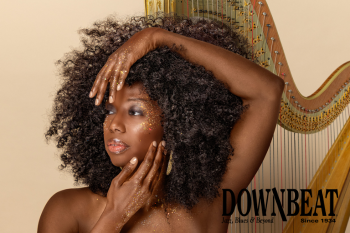
Few have done as much in recent years to showcase the versatile abilities of the harp as Brandee Younger. Her latest record, Gadabout Season, focuses on original writing, producing 10 tracks of new material accompanied by Rashaan Carter on bass and Alan Mednard on drums. 

Recording with Alice Coltrane’s harp (Younger became its custodian in 2024), tracks like “End Means” channel Coltrane’s signature spiritual work, plucking languorously across the strings while featured flautist Shabaka trips through melodic lines that interweave with Mednard’s textural drumming, and “Reflection Eternal” gestures towards Coltrane’s ambient compositions. Other influences include Dorothy Ashby’s use of harp as a vocal top-line on “New Pinnacle,” picking out earworming motifs amid Carter’s loping bass rhythm. 

Gadabout Season is a testament to Younger’s own developing style. “Breaking Point,” for instance, builds sharp interjections of harp melody over Mednard and Carter’s driving groove, sitting somewhere between swing and funk breakbeats, while “BBL” showcases Younger’s dextrous fingerpicking style, veering effortless to melodicism that echoes the impressionism of Debussy and Ravel, the band’s fifth outing stakes its place among the best recordings of this decade. 

The opening “Ware” illuminates the lineage from Newk and Trane to the titular David S. Ware with a fervid rhythmic underpinning and Lewis’ meditative lead, while “Remember Rosalind” layers a winsome melody over Chad Taylor’s slowly churning accompaniment. 

The oft-recorded “Left Alone” drifts on Taylor’s reiterative foundation and Brad Jones’ resonant toms, providing fertile ground for Lewis’ rich exposition of the Billie Holiday/Mal Waldron melody. 

Above all, this is a band that appreciates texture. “Multicellular Beings” and “Per 7” are both prime examples of how these four can shift their traditional roles to build performances that seem so purpose-built that listeners may mistake them for through-composed work. 

Over the course of its five recordings, Lewis’ quartet has grown into the one of the most eloquent improvising groups in recent history. They appear to be transforming their 41-year-old Swiss boutique label the way John Coltrane did for Impulse! in the ’60s. —James Hale

Brandee Younger on TKA

via Dowbbeat.com

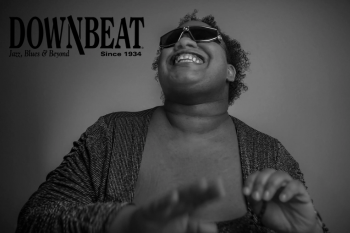
Since she was 3 years old, Brittany Davis has been mimicking bird songs on the piano. Davis, who was born blind, also recalls growing up listening to gospel and the contemporary jazz her family would play in the house.
“But I wasn’t really into … the real juicy stuff, the jazz linguist type [music], you know what I’m saying?” Davis said. “They had the lingo, man, and I wasn’t hearing that.”
While Davis is bashful about associating herself with the title of “jazz musician,” her sophomore LP, Black Thunder (Loosegroove Records), gleams with those “juicy” jazz elements she never fully understood as a kid.
Black Thunder, the result of a completely improvised two-day session at Seattle’s Studio Litho, draws on Davis’ organic connection to spirit, song and soul, and the synergy between Davis and two stalwarts of the Seattle jazz scene: drummer D’Vonne Lewis and acoustic bassist Evan Flory-Barnes.
The record includes nine songs with eight otherworldly interludes soaked in Afrocentric elements, groovy vamps and powerful lyricism sung or spoken in Davis’ rich alto. Thematically,
Black Thunder shares Davis’ bittersweet reflections as a blind person of color, encourages others to connect with their true beauty and highlights a gift Davis usually keeps close to the heart — a strong spiritual sense that connects her to the voices of the ancestors.
“It’s energetic. It’s interpretive. It’s a dance of sound and vibration. It’s a memory, it’s a wash. It’s washing over you. It’s not me going, ‘I see the spirits.’ No, it’s not like that,” she said.
After spending most of her childhood in Kansas City, Missouri, where she played piano in church and was first exposed to gospel and jazz, Davis moved to Seattle at 15. Within a few years, she’d befriended mainstays in the Seattle rock ’n’ roll scene and was regularly attending jam sessions.
Eventually, Davis was introduced to Pearl Jam’s Stone Gossard. Gossard quickly became a friend and one of Davis’ biggest supporters, signing her to his label, Loosegroove Records, in2022. Gossard’s help, as well as that of Pearl Jam producer Josh Evans, was instrumental in the creation of Black Thunder, as well as her 2022 EP, I Choose To Live, and her 2024 LP, Image Issues.

“Stone, he’s like, ‘Brittany, I bet you could go in the studio and make an album in three days.’ And I was like, ‘Yeah, no dude,’” she said, with a laugh. “But then, all of a sudden, this dude goes ahead and puts the whole [session together].” 

On the first recording day, Gossard and Evans brought in Lewis, a versatile and perennially in-the-pocket drummer who’s worked with Gossard, as well as Wynton Marsalis and Maria Schneider. On the second day in the studio, they also brought in Flory-Barnes, a skillful bassist and Origin Records artist who played with pianist Aaron Parks in his early trio. 

“I’m telling you, it was just like fate that brought that band together again, because we had played together before, but it just bounced back into my heart,” said Davis. 

While making Black Thunder, Davis came to the studio with nothing but an open mind and the intention of following the music wherever it wanted to go. She’d sit at the piano and start in with a groove or harmonic progression, letting Lewis and Flory-Barnes join in when it felt right. 

Quickly, she felt moved to voice the pain of the African ancestors, specifically those who were removed from their homelands during the transatlantic slave trade. She was also curious to explore how the atrocities and displacement that faced the ancestors continue to shape the Black community today. 

That inspiration is potent on the album’s suspenseful eponymous track, “Black Thunder,” as Davis speaks: “It’s rainy season/ In the jungle I hear, the call of wild souls/ Who never knew, what it meant to leave their soil/ I can hear it down underneath the soil/ Tempered and wired tight/ Ready, preparing to bring forth light and fruit.” 

As it explores this legacy and Davis’ relationship to it, Black Thunder incorporates African chants and rhythms, jazz harmony, soulful vocals and spoken-word verses. As pearls poured forth, Evans would carefully layer, edit and shape it all into refined tracks.
“Amid The Blackout Of The Night,” featuring soft, sensitive drumming from Lewis and a bluesy piano solo from Davis, explores what it feels like for Davis to have knowledge of something visual, like the Milky Way or the construct of race, but no context to truly understand it as a blind person.
“It’s a type of pain and uncertainty that will cause you to break free and become curious,” she says. “[D’Vonne] picked up on it and dropped in that beat. And then it took me to the place of curiosity I needed to go.” 

Likewise, “Mirrors,” driven by a melancholy, marimba-like keys pattern, aches with the tension between Davis’ sense of her own beauty and the narrow, often racist, beauty standards of the sighted world. 

“I’ve always believed that I’m beautiful. I’ve never had a problem with me. When I wake up in the morning, when I take that first deep breath, ‘Oh, wow, I’m beautiful.’ I’ve never had a problem with beauty until it becomes, ‘Your hair ain’t right. Your clothes ain’t right,’” she said.
Throughout Black Thunder, time and the material plane transform at the thrum of a bass note or a cymbal splash. Meanwhile, Davis harnesses uncanny sentience and vulnerable self-reflection, aiming to reveal her authentic self, dispel society’s projections and ultimately help others connect to their soul’s purpose.
“I would love to see people remember their humanity. I would love to see people embrace their flaws. I would love to see people embody their fullness,” Davis said. “We don’t need another person that we want to be like. Because the only person we should want to be like is the one that God made. That’s you.”

—Alexa Peters

Brittany Davis on TKA