via thefrontrowcenter.com
There is a particular kind of evening that arrives in a concert hall when the musicians onstage cease to be performers and become, instead, conduits for something far older and more luminous than themselves. Wednesday night at the David Geffen Stage at Kaufmann Concert Hall, inside the storied 92nd Street Y on the Upper East Side of New York City, was precisely that kind of evening. Before Arturo Sandoval even set foot onstage, his ensemble—a cohort of world-class instrumentalists—launched into a blistering, virtuosic opener at breakneck tempo, trading improvised solos over the song’s form and exchanging crackling fours with drummer Daniel Feldman. The rhythmic dialogue was electrifying, each musician’s statement more incendiary than the last. The message was unmistakable: tonight, the bar would be set at the stratosphere.
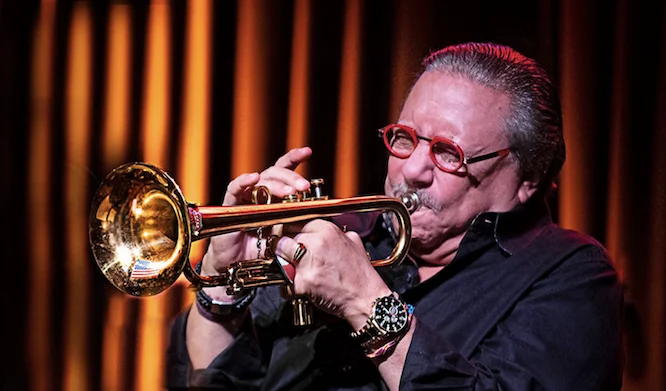
Then, from behind the stage curtain, a hand appeared—a small wave, a welcoming grin—and Sandoval stepped into the light. At seventy-seven years old, the Cuban-born trumpet titan remains a force of nature: a ten-time Grammy Award winner, Emmy recipient, Presidential Medal of Freedom honoree, 2024 Kennedy Center Honorslaureate, and a protégé of the incomparable Dizzy Gillespie. To catalog his accolades is to recite a litany of modern jazz’s highest distinctions. Yet none of that quite prepares you for what happens when the man raises his horn and plays.
AN ENSEMBLE FORGED IN MUSICAL FIRE
As the great critic and historian Gary Giddins once observed, the truest measure of a bandleader’s artistry lies not only in what they play but in whom they choose to play beside them. By that measure, Sandoval’s ensemble is a masterwork of curatorial intelligence. On tenor saxophone, Michael Tucker—a Grammy-nominated powerhouse from Berklee College of Music and the New England Conservatory—delivered solos of startling fluidity and harmonic depth, engaging Sandoval in fiery call-and-response and unison passages that recalled the golden dialogues of bebop’s founding era. Alongside him, baritone saxophonist Larry Bustamante, a New York City native whose pedigree includes the Afro Latin Jazz Orchestra and the Mingus Big Band, provided a rich, anchoring bottom voice that lent the horn section its full-bodied resonance.

Arturo Sandoval at the 92nd Street Y in NYC. L-R: Lisandro Pidre, Piano; Roberto Vizcaino, Drums; Arturo Sandoval, Trumpet; Michael Tucker, Tenor Saxophone; Larry Bustamante, Baritone Saxophone; Keith Fiala, Trumpet; and William Brahm, Guitar. Photo by Edward Kliszus
On trumpet, Keith Fiala stood as both disciple and collaborator. A former touring member of Maynard Ferguson’s celebrated Big Bop Nouveau Band and longtime associate of Sandoval, Fiala brought a bright, muscular tone and precision to every passage. Meanwhile, guitarist William Brahm—a Los Angeles-based artist and 2019 Herbie Hancock Institute semifinalist who has toured with Sandoval since 2019 and performed with Gordon Goodwin’s Big Phat Band—wove sophisticated comping and luminous solo lines throughout the evening, his Stratocaster singing with a Jeff Beck–inflected lyricism. Pianist Lisandro Pidre, an Argentine virtuoso whose résumé includes performances with Dave Weckl and orchestral conducting in Mexico City, provided harmonic sophistication and an impeccable rhythmic feel, shifting between accompaniment and solo passages with the assurance of a seasoned auteur.
In the rhythm section, bassist Maximilian Gerl—a Berklee honors graduate from Dallas who has performed with Stanley Clarke, Makaya McCraven, and Veronica Swift—proved nothing short of astonishing. As the bebop tunes roared at dizzying speeds, Gerl navigated the changes on the upright bass with two fingers alternating across the strings, his walking lines powerful, precise, and impossibly locked in. One could scarcely tap a foot fast enough to keep pace, yet Gerl never wavered. Drummer Daniel Feldman drove the ensemble with an unerring pulse, alternating between explosive polyrhythmic fills and sensitive handwork that recalled the kinetic grace of the great Afro-Cuban percussionists. And on congas and percussion, Roberto Vizcaino—son of the legendary Cuban multi-percussionist of the same name, a two-time Latin Grammy winner, and currently a member of Chucho Valdés’ Royal Quartet—laid down rhythmic patterns of intoxicating complexity, his hands summoning the ancestral pulse of the clave with a master’s authority.

Arturo Sandoval, renowned Classical Musician. Courtesy arturosandoval.com
BEBOP, THE AMERICAN SONGBOOK, AND THE LATIN SOUL
LeRoi Jones—later Amiri Baraka—wrote in his seminal Blues People that the story of jazz is inseparable from the story of a people’s liberation, and Sandoval’s biography embodies that thesis with rare poignancy. Born in Artemisa, Cuba, in 1949, he overcame political oppression to bring his boundless gifts to the world stage, defecting with the help of Gillespie during a tour with the United Nations Orchestra in 1990. On this evening, that journey was palpable in every note. Sandoval delivered a masterclass in bebop for the audience, explaining the form’s virtuosic unison fire—its roots in the late 1940s and its architects: Gillespie, Charlie Parker, and Clark Terry. He characterized each of these titans with humor and affection, stepping into their caricatures with a raconteur’s delight and a historian’s reverence.
The program itself traversed a thrilling landscape. Latin works of incandescent rhythmic vitality—including “Sangu” from Sandoval’s latest album—ignited the hall with their syncopated drive and percussive brilliance. The unison bebop heads, performed at breakneck tempos, showcased the ensemble’s astonishing technical command and collective telepathy. And then there were the gems from the American Songbook: Ray Noble’s “Cherokee” tore through the hall like a benevolent gale, and Henry Mancini’s “The Days of Wine and Roses” became, in Sandoval’s hands, something transcendent. He began alone at the piano, exploring the melody with a Romantic, almost Satie-like tenderness and the harmonic richness one associates with the great Kenny Barron, before Gerl and Feldman joined him in a medium swing that built and blossomed like a garden in time-lapse. It was marvelous, moving, and deeply virtuosic.

Arturo Sandoval, trumpet, and Michael Tucker, tenor saxophone, on stage at the 92nd Street Y, NYC. Photo by Edward Kliszus
THE POLYMATH AT PLAY: TRUMPET, PIANO, TIMBALES, AND THE HUMAN VOICE
I have been fortunate to see Sandoval perform several times over the years. I recall a concert decades ago at The Blue Note jazz club in Greenwich Village, expecting an evening of magnificent trumpet. What I received instead was a revelation: Sandoval rotating from trumpet to piano to timbales and cowbell with equal aplomb, a polymath in full flight. Wednesday night confirmed that the passage of time has only deepened his mastery. As Leonard Feather might have wryly noted, Sandoval at seventy-seven is more dangerous than most musicians half his age—his fingers faster, his musical vocabulary richer, his sense of drama more refined.
He moved between instruments throughout the evening with the ease of a man walking through the rooms of his own home. His trumpet playing remained fearsome—traversing registers from the instrument’s deepest, warmest tones to stratospheric high notes, delivered with dazzling technique and a tessitura that defied belief. At the piano, he conjured expressive, richly textured voicings. On the timbales, he channeled the percussive fire of his Cuban heritage. And then came the singing. Sandoval confessed, with characteristic self-deprecation, that he never liked his singing voice—but that at sixty-five, it had finally matured. He proceeded to deliver Charlie Chaplin’s beloved “Smile”—nodding to Nat King Cole’s iconic rendering—with a tenderness that hushed the room and elicited, true to the song’s title, many smiles. Perhaps this performance represented the grace and comfort of a great artist’s elder years, especially when one loves music as deeply as Sandoval and his fellow artists and audience so clearly do.
His scat singing was equally revelatory. Initially drawing affectionate chuckles, Sandoval soon clarified that scat was no mere novelty but a serious musical discipline that excited the imagination and imposed few limits—an insight that the pioneering vocal improvisers from Ella Fitzgerald to his mentor, Gillespie, would have endorsed wholeheartedly.

Arturo Sandoval. Trumpeter, Composer, and Pianist. Courtesy arturosandoval.com
THE RACONTEUR: HUMOR, HEART, AND THE ART OF CONNECTION
What separates Sandoval from so many other virtuosi is his extraordinary gift for human connection. He is, quite simply, a charming raconteur with a wealth of anecdotes and a laid-back, self-deprecating cleverness that makes you feel as though you are conversing with an old friend over café con leche. He joked about the challenges of learning English after arriving from Cuba at forty, noting with infectious wit that English words are too vague and their rules too capricious. At the same time, Spanish, by contrast, is more logical, with sounds and words that behave themselves. This riff culminated in a hilarious bilingual exchange between Sandoval, Vizcaino, and Feldman that had the audience roaring.
He spoke candidly about the trumpet’s unforgiving nature—this brass object, he called it, with the comic timing of a man who has spent a lifetime taming it—and about how the piano, by contrast, is a forgiving instrument that he neglected in his youth because, in Cuba at the time, boys simply did not play the piano. Despite that early admonishment, his pianism tonight was sublime. Sandoval reminded the audience, with genuine humility, that the music they enjoyed was the product of many thousands of hours of practice by the individuals onstage. It was a gracious, democratic moment: the maestro insisting that the glory belonged to the collective.
A STAGE BEAUTIFULLY LIT AND LOVINGLY MANAGED
A brief word must be said about the production values at Kaufmann Concert Hall. The lighting design was thoughtfully executed, shifting hues to set moods that mirrored the music’s emotional arc—warm ambers for ballads, cooler blues for the Latin passages, saturated tones for the fiery bebop numbers. Sound engineering was equally well managed, balancing the ensemble’s dynamic range without sacrificing intimacy. The 92nd Street Y continues to demonstrate why it has earned its reputation as one of New York’s finest concert venues.
AN EVENING TO REMEMBER: WHY ARTURO SANDOVAL STILL MATTERS
In the end, what Sandoval achieves transcends technical virtuosity—though his technique remains among the most prodigious in the history of the instrument. What he achieves is something that the philosopher and musicologist Theodor Adorno would recognize as art’s highest aspiration: the capacity to make the complex accessible, the intellectual visceral, and the beautiful urgent. He makes music fun, important, interesting, and deeply human. His concert was a vivid reminder that jazz, at its best, is not a museum piece but a living, breathing, joyously present art form.
As the final notes faded into the rafters of Kaufmann Concert Hall, the standing ovation that erupted first from those dancing in the audience was not merely for the astonishing musicianship on display. It was for the spirit—generous, exuberant, unquenchable—that Arturo Sandoval continues to bring to every stage he graces. He is, in every sense, a national treasure, and his ensemble a sterling reminder that the art of jazz performance remains alive and magnificently well.