via popmatters.com
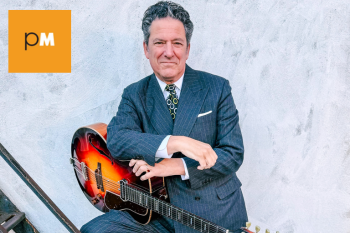
Guitarist and singer John Pizzarelli has been working professionally for about 45 years and has recorded over 30 albums as a leader. Pizzarelli’s preferred format is with a trio, in the style of Nat King Cole: his swing-styled seven-string guitar, piano, and upright bass — and his casual but confident vocals.
For all his success and longevity, Pizzarelli, coming up on his 66th birthday, seems youthful — funny and easygoing as a personality and, inevitably, always the son of his legendary dad, the guitarist Bucky Pizzarelli. Behind that casual front, though, Pizzarelli is also an exacting musician.
The John Pizzarelli Trio has never sounded better than on its new album, Dear Mr. Bennett. Commemorating the centennial year of singer Tony Bennett, the album features not only classic standards and Bennett’s signature tunes, but also some lesser-known tunes such as the charming “It Amazes Me”, which Pizzarelli unearthed in considerable research he put into the project.
As Bennett’s birthday approaches on 3 August, Pizzarelli will release four more tracks, including a couple of songs by Duke Ellington and a guitar solo of a song from Bennett’s recordings with jazz pianist Bill Evans.
Pizzarelli is joined for the second time on record by pianist Isaiah J. Thompson, who is the most formidable keyboard partner Pizzarelli has ever had. Bassist Mike Karn, steady and beautifully recorded here, has been in the trio for a decade. This format — no drums, just guitar, piano, and acoustic bass supporting Pizzarelli’s casual but increasingly wonderful singing — is familiar to any fan of the early Nat Cole Trio.
John Pizzarelli is the contemporary master of this instrumentation. His guitar, a band unto itself with that additional low string allowing him to drive the band on his own, can take up plenty of space or blend into the band with equal skill. Thompson is only 29 years old, but he has the full sweep of jazz piano history in his hands. More than any other Pizzarelli pianist, he can update the trio’s sound to include modern jazz as well as play within its “swing era” core sound.
The result is that this version of the trio has astonishing range, and this suits a set devoted to Tony Bennett, who may have been the most versatile of all jazz singers. Bennett’s bel canto roots gave him the power and bravado to equal that of big bands or orchestras, but plenty of the crooner’s best work was created in intimate settings.
Much of my favourite material on the new album comes from the repertoire that Bennett developed with pianist Bill Evans for their two duet albums, recorded in the 1970s. Pizzarelli’s trademark intimate and light vocal delivery beautifully serves this material — such as the Evans classic “Waltz for Debby”, Cy Coleman’s “When in Rome”, and the standard “Young and Foolish” — but these performances also demonstrate how Pizzarelli’s singing has increased in gravity and emotional nuance over more than 40 years of development.
“Waltz for Debby” features Pizzarelli alone, his barely amplified guitar playing the shimmering harmonies with a warm precision, and “Young and Foolish” omits guitar entirely — piano and voice alone until Thompson’s solo draws flawless support from Karn’s bass. These two tracks alone lift Dear Mr. Bennett straight to the top of John Pizzarelli’s long discography.
Instrumentally, the band sparkle with wit, plays with fire, and can paint in pastels as required. If you have seen the trio in concert, you know that it swings hard. In a small club, a trio without drums but animated by sharp rhythmic interplay isn’t loud, but it is forceful — Pizzarelli’s group pops. Each player leaves open spaces but also enters with force. A ripping line from Thompson’s piano, for example, hits with extra power because he isn’t always filling the sonic space. Arrangements stagger sections of solo, duo, and trio playing.
For example, the Duke Ellington classic “It Don’t Mean a Thing” starts with only Karn’s walking bass for 12 bars, after which stop-time sections feature piano only or just the leader’s guitar in unison with his scatted vocals. A similarly styled guitar solo cruises with piano and bass cooking before the band cuts out and John Pizzarelli is alone, playing only the lowest strings of his guitar, strummed in a vaguely Deep Purple rock style. The variety of sounds is refreshing and fun.
PopMatters interviews John Pizzarelli about the new album
Your connections to Tony Bennett are many — through your dad, playing with him yourself, and having him come to hear you playing in New York City, so many. In addition, you are both part of a tradition of Italian American jazz musicians. Is that a meaningful connection?
Good Question. Maybe there is an internal kind of thing, a sort of ethnic pride. We play with some excitement, I suppose. For example, I love hearing guitarist Matt Munisteri playing with the singer Catherine Russell. The great musician Joey DeFrancesco [who played organ, trumpet, and even some saxophone] was proudly Italian-American. The last time I saw Joey on the jazz cruise, I asked him where his family came from in Italy. When they auctioned off a bunch of Tony Bennett’s stuff after he died, the material included a sketch of Geno’s on Lexington Ave and 61st Street in Manhattan, an Italian restaurant where we used to eat.
He was a real fixture in New York, almost a regular guy.
Absolutely. You could see him walking around the city. He liked to go to clubs and restaurants in New York. The cover of the new album is a drawing he made of me on a napkin when he came to see my play. He was around. It wasn’t like he was in Sinatora. Everyone was cool with Tony Bennett, and I loved his “regularness”.
Part of what made Bennett such an Italian singer was his connection to the big-voiced “bel canto” singing tradition, but he also sang with great intimacy.
He changed his style. When he made the records with jazz pianist Bill Evans, he had to and did sing differently. His voice was still in great shape at the end of his life — he knew how to hit the high notes even at the end. He could use his voice in an entertaining way. But the key to Tony Bennett was this: you could see him pick great songs as his career progressed. You could see him thinking, I’m not going to screw around anymore.
Bennett started as a pop singer and had hits. Then he really transitioned into being a “jazz” artist.
He made more hit records than Sinatra did for a time, like “The Shadow of Your Smile”. They were well-made records that landed perfectly on the easy listening stations. Things changed, of course, in pop music in the 1960s, but he was also in with interesting people like the singer Annie Ross [of the jazz group Lambert, Hendricks & Ross]. She is the one who told him he should make the record with Bill Evans.
In the 1970s, Tony landed on his feet, making great music. He had the two Evans duet records, and also “Life Is Beautiful” in 1975, which my dad, Bucky Pizzarelli, was on.
On Dear Mr. Bennett, you have three songs that were on the Bill Evans records.
When I worked with Jonathan Schwartz [the New York area radio personality known for his knowledge about and devotion to the “Great American Songbook” repertoire] in the 1980s, he pointed me in the direction of those Bennett/Evans records. I was doing “When in Rome” in the 1980s for that reason. That material has been like a good bottle of wine, every year that I’ve listened to it. It’s grown on me — it’s like classical music.
When the compilation 40 Years: The Artistry of Tony Bennett came out in 1991, you could discover all these cuts you had never heard before. The tracks featured great arrangers Don Costa and great players like [saxophonist] Zoot Sims. There was amazing artistry and beautiful arrangements amidst the hits.
Doing tribute albums seems to push you to learn new repertoire. You have done recordings related to Nat Cole, of course, and Sinatra. Of course, there is no shortage of new stuff in the Great American Songbook, but it is also true that the same songs can get done to death. On Dear Mr. Bennett, “Firefly”, “It Amazes Me”, and “Because of You” were all new to me.
You get pushed. When I do these records, I try to do research and learn more. “Because of You” was the title track of Tony’s debut album [in 1952] and was a hit pop record with strings, but I had to translate it into my own style. My wife Jessica Molasky sang “It Amazes Me” at the Cafe Carlyle, and it’s on the Bennett MTV Unplugged record.
“Firefly” is on Tony Bennett at Carnegie Hall [from 1962]. I got a note about “Firefly” the other day from a guy. Cy Coleman wrote it with Carolyn Leigh as an audition song for the musical Gypsy. They didn’t get the gig [it went, instead, to Stephen Songheim and Jule Styne], but Tony recorded the song a few years later.
Tony had this ear and developed a unique repertoire. In that way, he was like Nat Cole and like Frank Sinatra.
Your sound as a player with your trio is quite locked in. Listening more closely, I hear an evolution — the band are becoming more dynamic, and your singing is deeper-toned, purer, more conversational, and more confident.
I feel like I’ve recorded a lot since 2021, and I’m more aware of my voice. I feel the same way that you do. I try to listen more to what’s coming out. And it’s the songs I sing, I can’t just keep singing Nat Cole’s “The Frim Fram Sauce” and feel satisfied. I had to invest more on this front. I think I’ve done it better on the last couple of records. I feel more comfortable, and the investment in my singing is paying off.
The trio arrangements feel more varied on the new album. It starts with you singing over just a bass line; you sing “Waltz for Debby” with just guitar, then “Young and Foolish” is just you and piano (until the bass works the piano solo). Also, the “It Don’t Mean a Thing” on this record is a fun track. Your guitar solo using only the low strings is something I’ve heard you do live but never on record. The trio generally sounds looser than what you normally put on tape. Is that a change in how you are approaching making records as you mature?
This version of the trio is very comfortable now. We are eight years in, having played together since 2018. The formulas we use in concert are now applied and more noticeable on this recording. The first album with Isaiah J. Thompson on piano, Stage and Screen, was made pretty soon after the pandemic, so we didn’t have much time invested. The more we’ve worked together, the more we know what we can do.
Isaiah is amazing. There is a masculinity to his piano style — he really dives in there. And he and bassist Mike Karn are very locked into how they play together. I’m chunking along, but they are incredible! I’ve worked with some other pianists when he wasn’t available, but there is something amazing about his personality on piano, it’s true!
That guitar style I use at the end of my “It Don’t Mean a Thing” solo was referred to as “the Zoom-Zoom” by my dad, Bucky. We did a bit of this on Stage and Screen, but we’ve been playing on the road, and it is here.
I’ve been following your “It’s Five O’Clock Somewhere” livestreams, where you take requests and play solo online. I think you started this during COVID. People are real fans who treat you like family. Has this changed or deepened your experience in playing live for people in clubs or concerts?
It seems like the pandemic gave social media a different weight. There’s been more emphasis on this from the clubs I play — they want me to publicise gigs on social media. It’s a way to be personal. It’s fun to do. I’m seeing the value of it. People talk to me from the audience much more now!
Read the Full Article Here
John Pizzarelli on TKA